
Ads & analytics
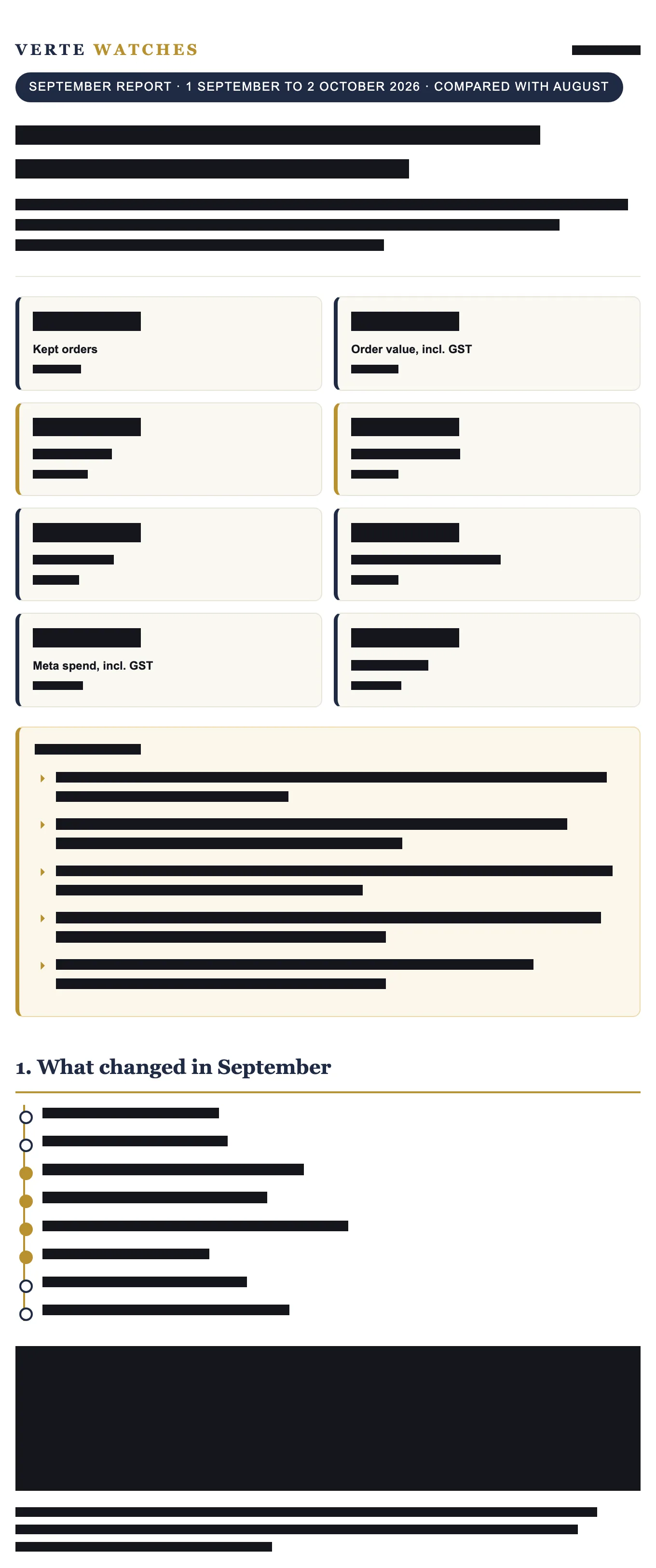
Meta ads for watch, apparel, real estate and EV brands, and the measurement behind them: reports that check their own numbers, leads that reach sales in seconds, and audits that follow the money past the click.
My role: Ran the ad accounts with the team and owned the numbers: structure, launches, reviews, reporting, pipelines and audits
1,603
Meta leads for a real estate developer, April to October, at about ₹183 ($2) each
10 to 12x
Verte's Shopify sales against Meta spend, June to August
698
leads delivered straight into sales sheets since 22 July
36
analytics reports delivered, each as HTML and a one-page PDF
01
The brief
The agency runs Meta ads for Verte and Alexandre Christie (watches), Season Earth (linen menswear), THS (real estate) and HarboCharge (EV charging), with no in-house performance marketer.
The job: run the accounts, and know what is really working. That means Shopify orders, leads the sales team can call and site visits they can book, not the purchases an ad platform claims for itself.
02
What I did
- Account structure, launches, budget proposals and kill or keep reviews for every brand.
- A reporting standard, and 36 reports built on it for Verte, Alexandre Christie, Season Earth, THS and prospects.
- Lead and abandoned-cart pipelines that put every lead in front of the sales team within seconds.
- Audits that follow results past the click: leads to site visits, failing funnels, and our own change logs.
- Rebuilt the customer lists behind four brands' lookalike audiences.
- Market research: a repeatable way to size competitors from the ad libraries, and a festive-season brief on the Indian ad market.
- Tools: SparrowOS analytics, MCP servers that let Claude query SparrowOS and Reddit Ads, and AdPilot, an assistant where the engine proposes, a person confirms and code executes.
03
How I did it
A standard before a verdict
Ads are judged on the funnel the platform actually measures (reach, frequency, CTR, CPM, clicks, spend and days live), benchmarked per market, since US CPMs ran about 13 times India's. Attributed ROAS can confirm a call but never leads one. Ads are judged at the ad-set level, because an ad with no sales is often the first touch that makes the next one sell.
Structure that keeps learning
One ad set per product per market, with location as a hard rule. No verdict until days live and spend give enough evidence. Market tests are built as paused drafts for approval, so nothing goes live by accident.
Reports that check themselves
Orders come from Shopify, never from an ad platform. A script re-derives every figure in a report and checks it against the document before it ships, and every report goes out as HTML plus a single-page PDF.
Leads in seconds, not days
Meta lead ads arrive through a webhook whose signature is checked, get answered fast, then are written to the brand's sheet from a queue with retries. A daily sweep reconciles anything missed. 698 leads have gone through it since 22 July.
Follow the money past the click
For THS, 90 days of leads were traced to site visits campaign by campaign. For Season Earth, a one-click checkout widget skipped the cart entirely, so add-to-cart was the wrong thing to measure; most people saw an ad only once, and broken tracking had starved the retargeting pool. For Verte's US Reddit test, three weeks of spend had produced no sales by Shopify's count or Reddit's own, and the rebuild got pass marks set in advance.
Fix the audiences under everything
Every brand's lookalikes turned out to be built from one shared list that was almost entirely one brand's customers. I rebuilt each brand's seed list with a spend value for value-based lookalikes, plus a deduplicated pool of 16,919 people across brands.
04
What it changed
160 → 300+
Verte orders a month: best month before, then July to September 2026
~₹183
per lead ($2) across 1,603 THS leads, April to October
~₹126
per lead ($1.30) for Beyond Horizon's launch campaign, across 91 leads
154
pre-launch registrations for Alexandre Christie's Cosmic watch
693 of 698 leads reached the sales sheet within 30 seconds. Half took 11 seconds or less.
In the sheet within 30 seconds: 693Took longer: 5
Of the 5 that took longer, 2 took a few minutes and the nightly sweep caught the other 3, hours later. One dot is one lead, and all it holds is a date. Names and numbers stay in the client's sheet. From the pipeline's own log, test leads removed. Meta's own count for 23 July to 6 November is 692.
Each brand's decisions now rest on numbers that reconcile with its own sales: Shopify orders for the stores, sheet rows and site visits for real estate. When the ads aren't the problem, the reports say so and point at what is.
05
Inside this entry
Running and auditing Meta ads for watch, apparel, real estate and EV brands: structure, launches, kill or keep reviews and budget proposals.
- Verte: best month up from 160 orders to over 300 (July to September 2026), with Shopify sales at 10 to 12 times Meta spend from June to August
- THS: 1,603 Meta leads from April to October 2026 at about ₹183 ($2) each
- One ad set per product per market, location as a hard rule, and no verdict before days live and spend say there is one
- Change-log audits that check our own edits before blaming the platform
- Kill or keep reviews and outage diagnosis down to the single ad
- Lead campaigns with website pixel events, and market tests staged as paused drafts for approval
Recurring analytics reports for the agency's brands, built from Shopify, Meta, Google Ads, GA4 and Clarity, each shipped as an HTML report and a one-page PDF.
- 36 reports delivered for Verte, Alexandre Christie, Season Earth, THS and prospects, each as HTML and a one-page PDF
- Shopify is the source of truth for orders; ad platforms are only used for attribution
- Every figure re-derived by an evidence script and asserted against the report before delivery
- Delivery-funnel metrics against per-market benchmarks instead of attributed ROAS
- Investigations on demand: bot traffic, alternate-day order dips and an ad history with significance tests
Rebuilt the customer seed lists behind four brands' lookalike audiences after finding they were all effectively targeting one brand's buyers.
- Audited the shared custom audience every brand was using: it was almost entirely one brand's customers
- Per-brand seeds with a spend value column for value-based lookalikes
- A deduplicated cross-brand pool, with a premium tier as the one balanced segment
- Designed the test: each brand's own value-based lookalike against a combined one, 14 days, no edits
Search audits and fixes across three storefronts: what Google can crawl, what only JavaScript shows, and the structured data each page needs.
- Search Console linked to GA4 for both Verte sites
- Raw HTML fetched as Googlebot compared with the rendered page to find JavaScript-only content
- Product JSON-LD, meta descriptions and H1s added without any visual change
A repeatable, evidence-only way to size the competition: Meta's Ad Library for auction size and share of voice, and Google's Ads Transparency Center through its internal RPC.
- Three query shapes: market size, the client's own share of voice, and whether a named rival advertises at all
- Ad headlines used as evidence of prices, offers and cash on delivery
- A positive control before any zero result is trusted
An internal brief on India's festive-season ad market: marketplace sale calendars, cost shifts and what they mean for our brands.
- Every one of its 129 figures re-derived and asserted by an evidence script
- Two QA rounds with the Analytics Toolkit before it went out
A business analysis and a lead-generation setup for a startup that turns EV chargers into a revenue stream for property owners.
- Business analysis and thesis document
- Website pixel that tracks calculator use, form steps and leads
- Website-leads campaign aimed at property owners and small businesses in Bangalore
Traced 90 days of Meta leads through to site visits for a real estate developer, campaign by campaign.
- Cost per lead and per site visit for each campaign
- Found an audience that still carried another brand's buyers
- Recommended better qualifying questions and lead IDs in the visit log
Search demand for stays near the Ranjangaon Mahaganpati temple, for a prospective stay operator, with the religious-tourism calendar behind it.
- Google Trends and Keyword Planner pulls, prepared and checked by script
- Year on year compared on complete seasons, which corrected an overstated decline
- QA sign-off and an assumptions log before delivery
A search demand study for alternative investment funds, PMS, private credit and GIFT City funds in India.
- Parser that extracts Google Trends data from saved pages
- Comparison across fund categories and regions
Research on advertising a Mumbai residential tower to buyers in the UAE across Meta and Google.
- Counted competing developers' live ads in the UAE from the Meta Ad Library
- Google Ads Transparency Center checked through its RPC, with a positive control first
- Withheld costed forecasts on purpose, since the prices were not developer-confirmed